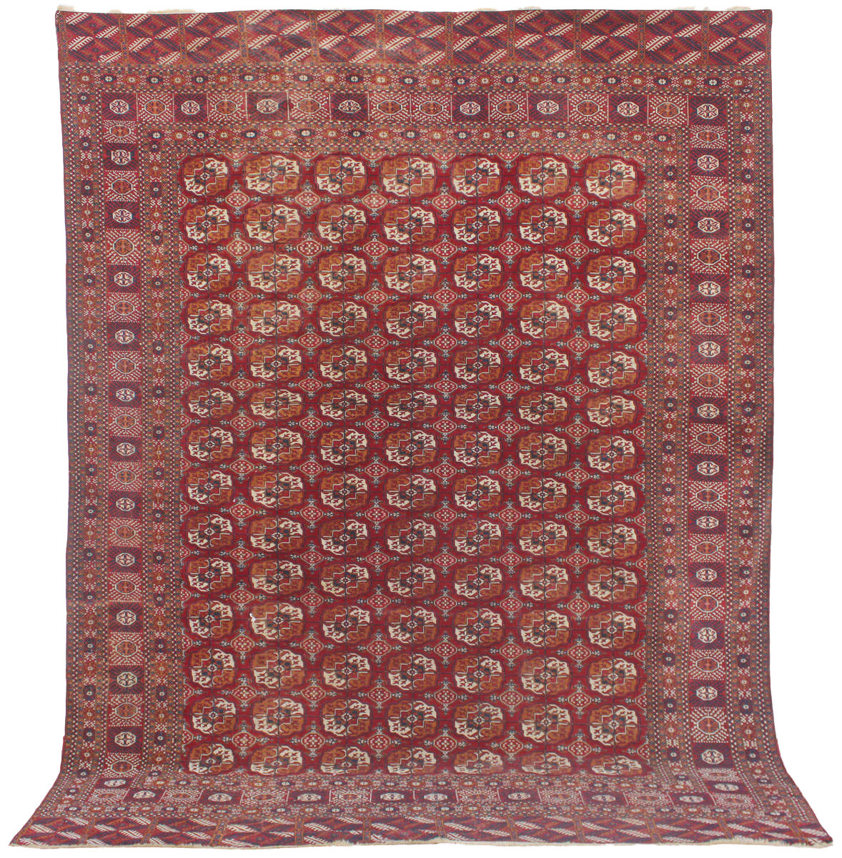
The repeated guls in this antique Tekke Turkman rug create a dense but highly ordered red field. Each rounded, angular compartment contains pale details and darker divisions, with smaller devices filling the intervals. The pattern is enclosed by several narrow bands and a wider border of compact geometric motifs. At the ends, slanting forms introduce a different rhythm from the disciplined rows within the centre. Red varies from warm brick to deeper wine across the composition, with cream, dark brown and restrained blue details sharpening the individual ornaments. The border is closely related in colour to the field, so this rug reads as a continuous textile surface rather than a pale centre inside a dark frame. That unity makes the small changes within each gul particularly absorbing.
Tekke carpets belong to the wider Turkmen weaving tradition of Central Asia, whose communities have lived across territories now divided between several modern countries. Repeated guls are an important feature of these carpets, although designs have circulated between groups. In this Tekke rug, guls and detailed borders form a closely integrated scheme, with the warm red continuing through each part of the composition.
At 348 × 273 cm, this rug would be well suited to a substantial study or sitting room. The red could sit confidently with dark timber and leather, while lighter fabrics would pick up its fine cream details. An arrangement that leaves the end borders exposed would show the full variety within its otherwise controlled composition.