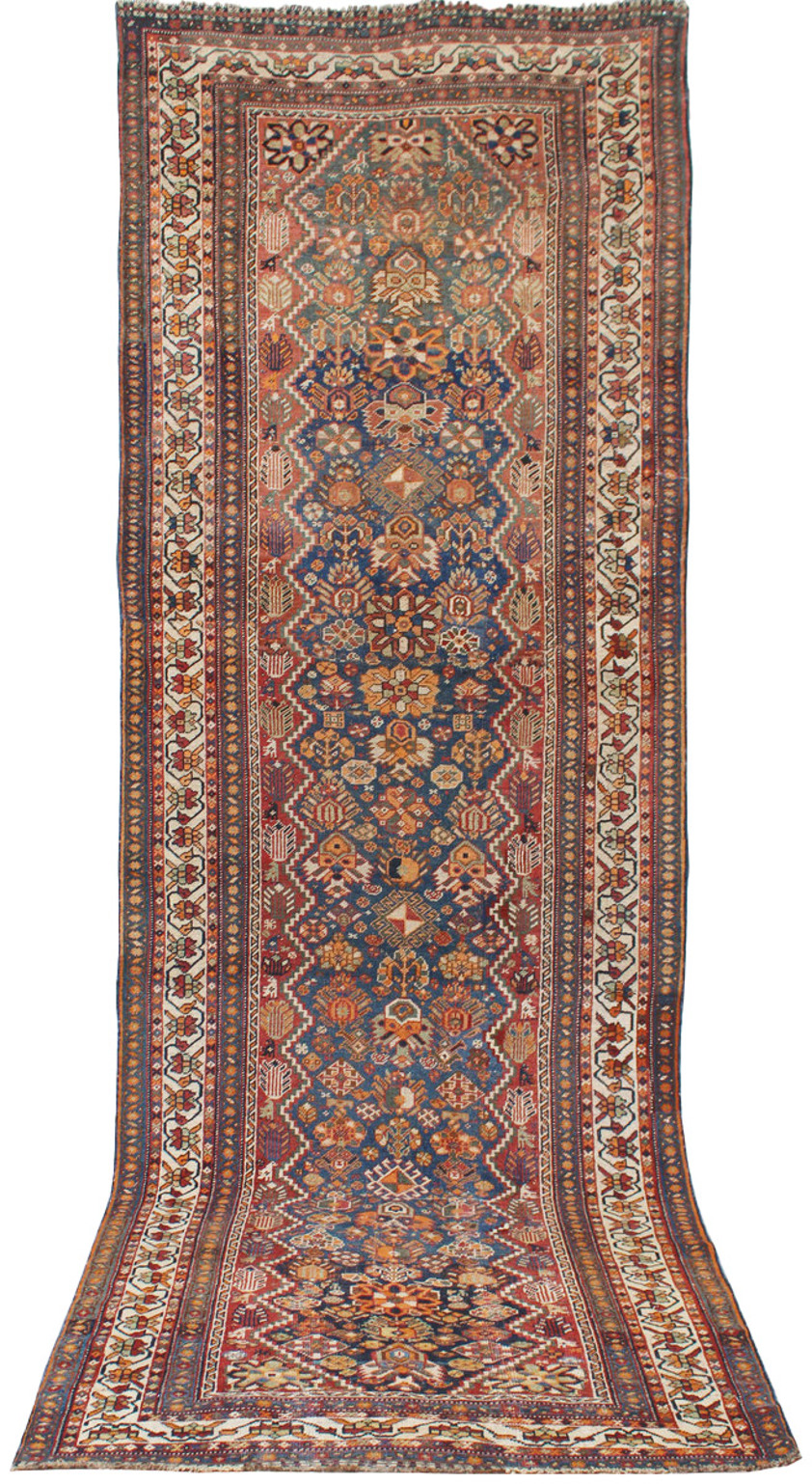
Fine floral and diamond-shaped forms fill the blue interior of this runner. Small rounded blossoms sit among angular linking devices, with pale details distinguishing their centres. Rust and ochre introduce warmer passages towards the sides and ends. The enclosing border is lighter, carrying a close sequence of botanical forms between several narrow patterned lines. Several scales of ornament work together. A small blossom has its own internal marks, and the angular outlines around it build into a larger repeat. Along the edge, the botanical sequence is more regular. A nearby view would reveal those little distinctions, while from farther away the runner would register through its blue middle and warmer enclosing bands.
Afshar weaving is associated with a widely dispersed tribal population in Iran, with Kerman province an important historical centre of its rug production. The designation encompasses varied geometric and floral arrangements rather than one fixed pattern. This antique Persian runner gives the smaller motifs a particularly extended setting, making their repeated relationships more important than a single large medallion.
The 280 × 106 cm format could suit an open passage or a clear floor area beside a bed. Plain walls would let the fine blue drawing remain apparent. Warm timber would connect with the rust and ochre, while cream fabrics could answer the pale border details. The full length would show how the tighter internal pattern is contained by the more continuous frame.