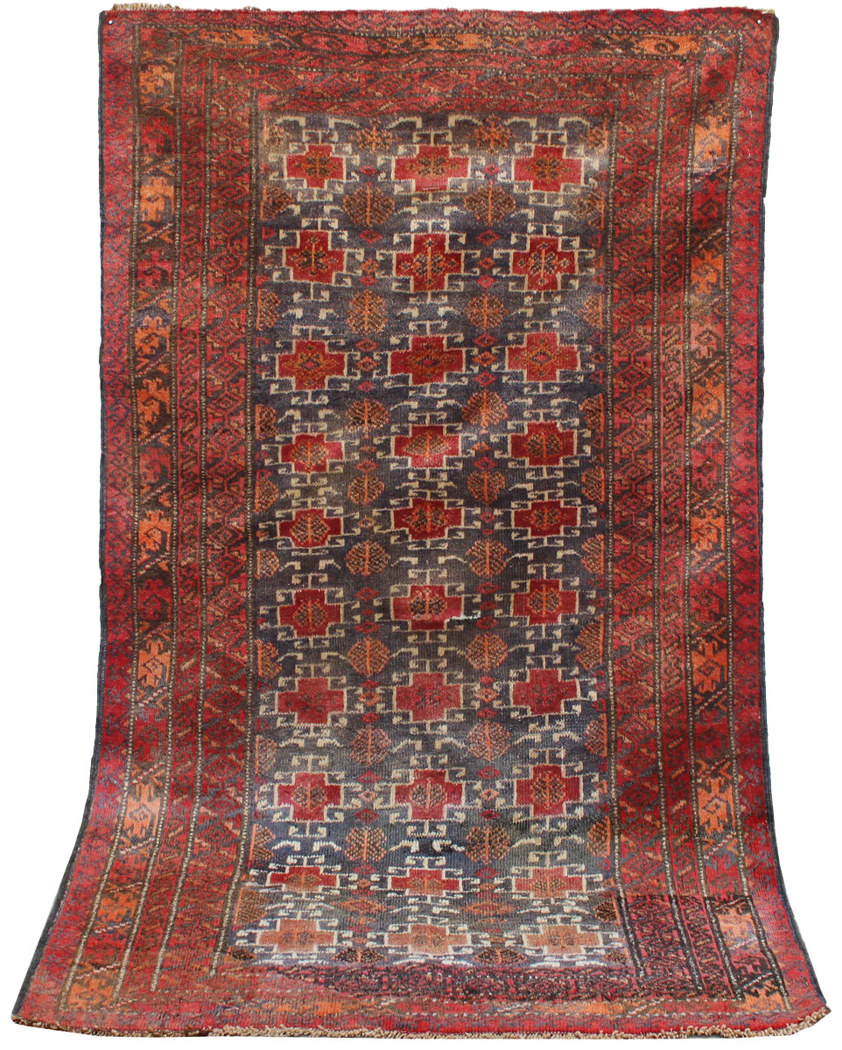
Rows of red geometric forms occupy the dark field of this small rug. Pale angular lines extend around and between them, creating an interlocking arrangement with many tiny internal divisions. The surrounding red border is broad in relation to the field. Several finer bands enclose its repeated ornaments, making the frame almost as important as the central pattern. The central units are related but not visually identical. Some red shapes are more conspicuous, while neighbouring pale lines provide short bright interruptions. At the edges, the scale becomes even finer, with closely placed devices moving around the corners. The small format allows a nearby viewer to appreciate field and border together, from the larger red forms to the tiny angular marks inside their outlines.
At 129 × 83 cm, the compact rectangle could bring close pattern to a small reading corner. Plain fabrics would leave the minute pale marks easy to see. Dark timber could relate to the field, and a muted red object would connect with the broad frame without introducing another pattern. Shirvan rugs belong to the varied weaving traditions of the eastern Caucasus. Their designs include closely repeated geometric fields as well as medallion and directional compositions, with small motifs often developed through elaborate internal detail. This antique example concentrates the ornament into a compact rectangle, giving the difference between dark field and red surround a particularly clear role.