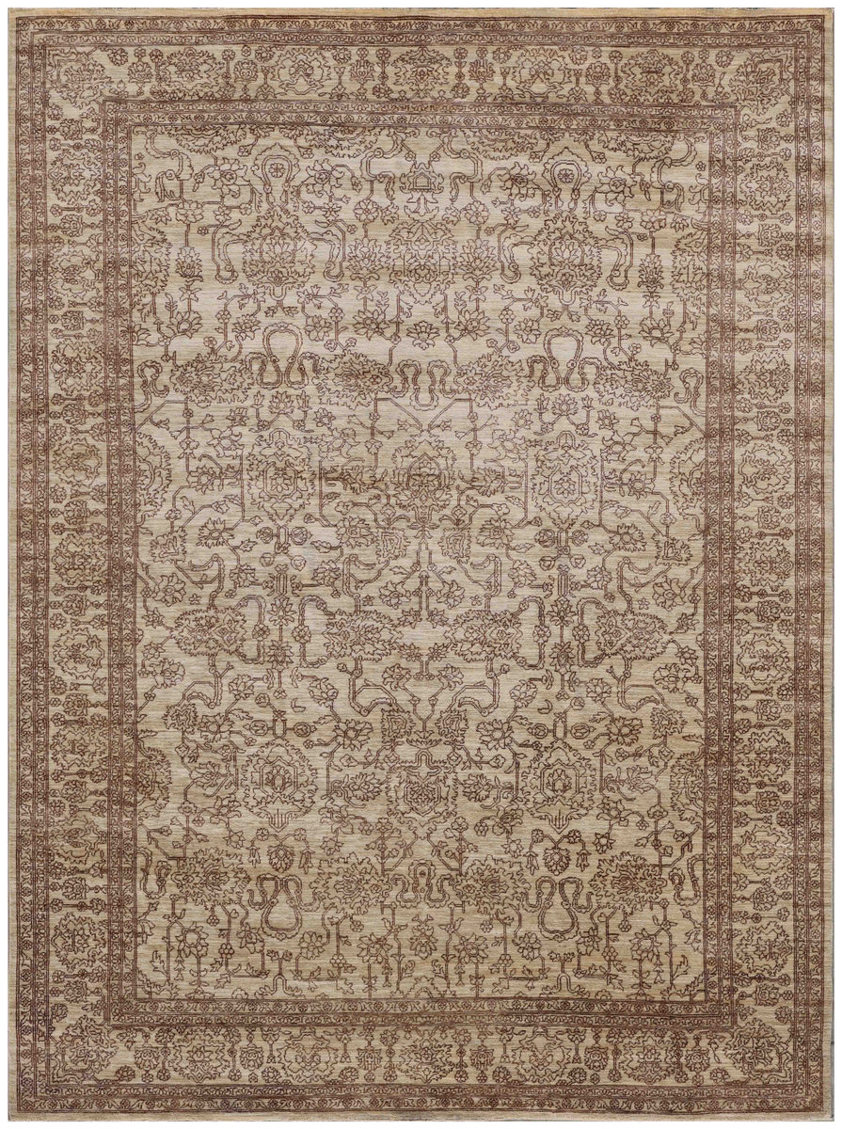
A close range of beige and brown tones gives this Afghan Ziegler rug its quiet presence. Large palmettes and curling stems can be followed across the pale field, but their outlines sit close in colour to the ground. The broad border repeats the floral theme at a smaller scale, producing a layered frame rather than a sharp change of colour. Fine guard bands add definition at the edges. The restrained palette allows the drawing to reveal itself gradually. Some areas are warmer and darker, while others approach cream, giving the surface a softly clouded appearance.
The larger flowers establish the composition; small leaves and connecting lines provide detail between them. There is enough pattern to engage the eye without creating a strong colour contrast. The Ziegler name recalls the Manchester firm's involvement in carpet production around Sultanabad, now Arak, in Iran during the later nineteenth century. Its carpets were developed for an international furnishing market. The design tradition continues in Afghan rugs, where large floral arrangements and furnishing palettes have found many interpretations. This rug gives that vocabulary a particularly subdued, tonal character.
At 416 × 304 cm, this rug would suit a spacious interior where furniture and architecture already supply considerable detail. Its beige palette could sit with stone, oak and linen, while darker furniture would give the pale drawing a useful counterpoint. A wide visible border would show the subtle progression between the principal field and its enclosing bands.