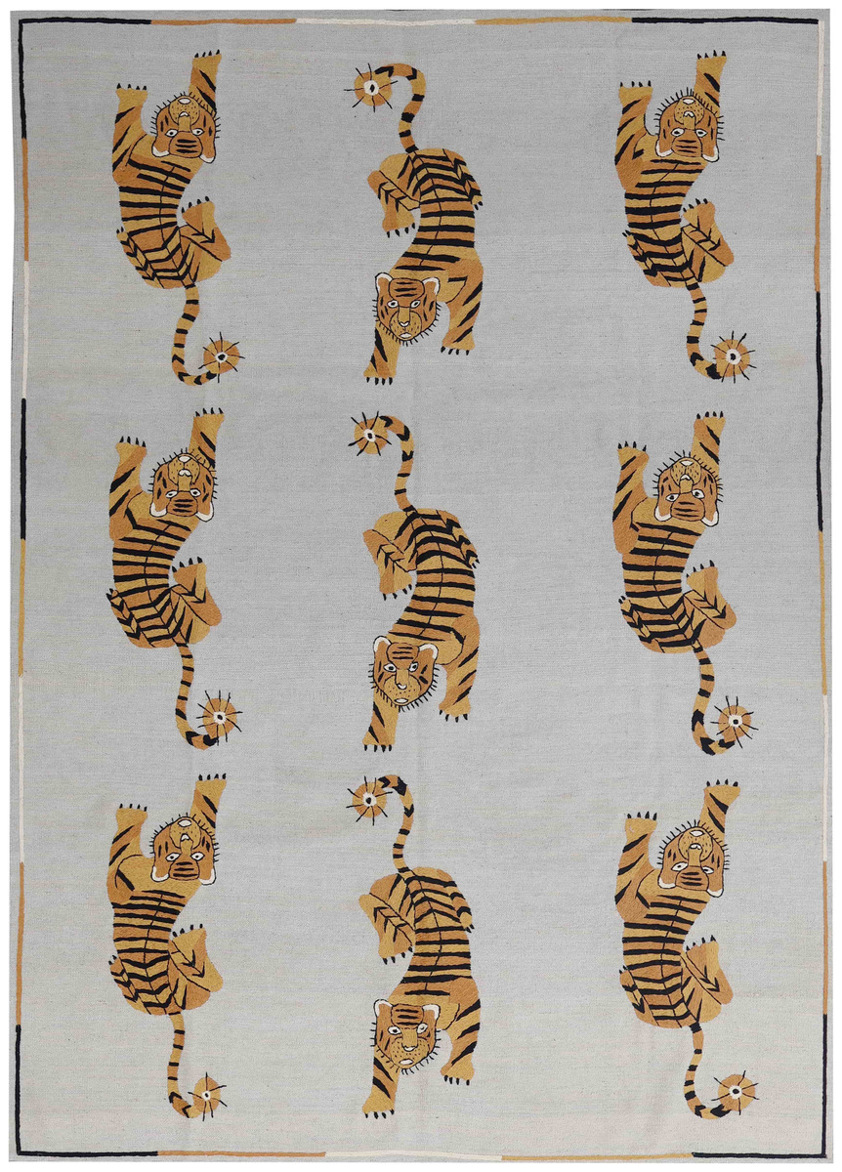
Pale grey gives the nine tigers in this rug a light, spacious setting. Golden bodies repeat in three rows, with the central figure in each row inverted. Raised forelegs and curling tails create an animated sequence, while dark stripes articulate the limbs and torsos. Pale facial details supply small points of contrast within the warmer gold. The animals are separated by generous intervals of background.
This prevents the repeated forms from merging into a continuous block and makes their changing directions easy to follow. A fine segmented line runs around the perimeter in pale, gold and dark sections. Subtle tonal variation within the grey gives the broad ground a softer visual texture beneath the more emphatic outlines. The suzani reference comes from the embroidered household textiles of Central Asia.
Covers and hangings could carry extensive ornamental schemes across broad surfaces, providing a historical context for contemporary Afghan kilims bearing the name. Here, an animal repeat supplies that ornament through spacing, scale and inversion. The design's visible structure can be appreciated without assigning an unverified symbolic role to the tiger or specifying an undocumented surface technique.
Its generous proportions could anchor a substantial seating arrangement. Grey fabric would connect with the background, while warm oak or ochre details might echo the animals. Leave several complete figures exposed around the furniture so the three-row rhythm remains clear and the pale intervals continue to give the composition its open character.