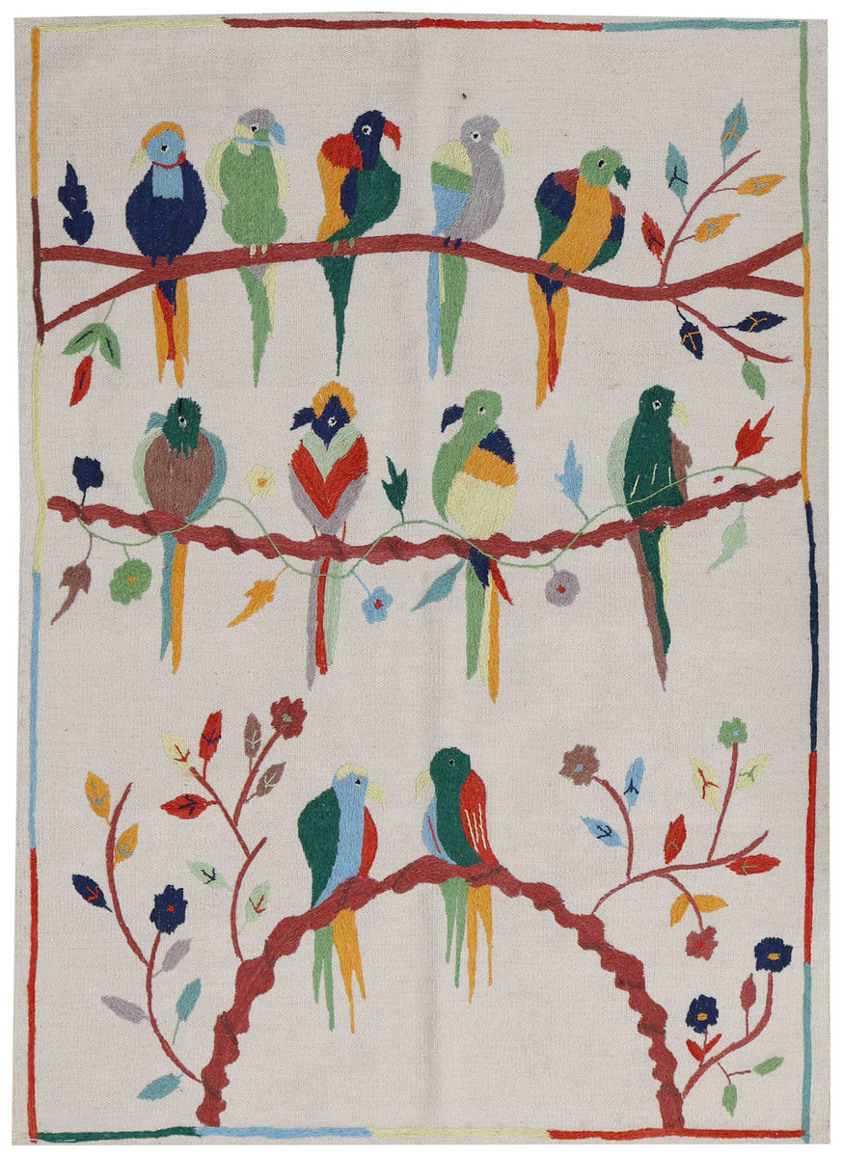
Red-brown branches carry three groups of parrots across the pale field of this rug. Long tails descend from the upper bough, adding slender strokes of yellow, blue and green to the open background. The middle birds are spaced more widely, while a pair sits above an arching trunk near the bottom. That progression gives the design a clear beginning, middle and end. Small flowers and leaves accompany the branches. Their fine outlines contrast with the broader areas of plumage, and the pale ground keeps the different subjects separate.
A slim multicoloured perimeter line supplies a discreet boundary. The balance of vivid birds and empty space makes the illustration legible across a room, while close viewing reveals smaller divisions in the wings and faces. The historical suzani tradition concerns embroidered covers, hangings and other household textiles of Central Asia. Birds and plant forms belong within its wider decorative vocabulary. Contemporary Afghan kilims using the name can adapt those subjects into more openly pictorial arrangements, as this three-level composition demonstrates.
Its imagery offers cultural context without requiring a particular symbolic interpretation or an undocumented account of surface stitching. Use the pale ground to lighten an area beside darker furniture. A simple wooden table would relate to the branching forms, while green upholstery could connect with the birds. Leave a portion of each level exposed so their changing spacing remains apparent, rather than allowing the whole design to resolve into a few isolated coloured tails.