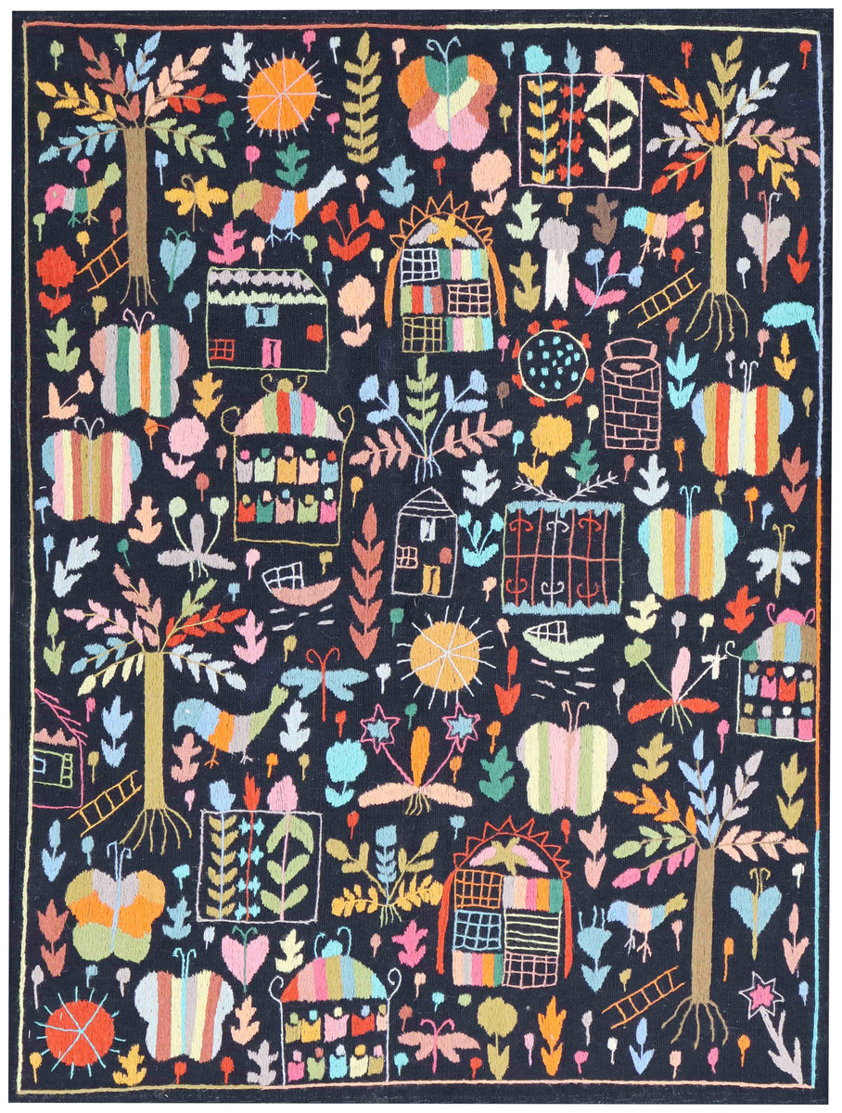
A dense collection of houses and plants covers the navy ground of this rug. Some buildings have rounded roofs, others are drawn as open grids, with butterflies and birds scattered between them. Pale yellow, pink, turquoise, orange and green give the many figures their individual colours. The dark background prevents these neighbouring motifs from merging, making even small outlines surprisingly easy to follow.
The field has a changing, almost illustrated rhythm. Large butterflies provide pauses among the finer stems, while circular figures and tiny flowers fill selected intervals. A thin light frame contains the collection without adding a substantial border. The visible surface gives the drawing a textile softness, but the bright colour patches retain their clear shapes. Historically, suzani describes Central Asian embroidered covers, hangings and other household furnishings.
Their abundant ornament offered a broad decorative vocabulary that contemporary Afghan kilims can interpret in different ways. Here, the emphasis falls on pictorial variety and the relationship between densely filled and lightly outlined forms. The design name supplies context, rather than a requirement to attach traditional symbolism to each house or creature. It would lend interest to a study or a sitting area with straightforward furniture. Cream fabric would contrast with the navy, while selected pink or yellow objects could repeat smaller accents. Allow a generous patch of the centre to remain uncovered, so its changing architecture and delicate plants are not reduced to details along the edges.