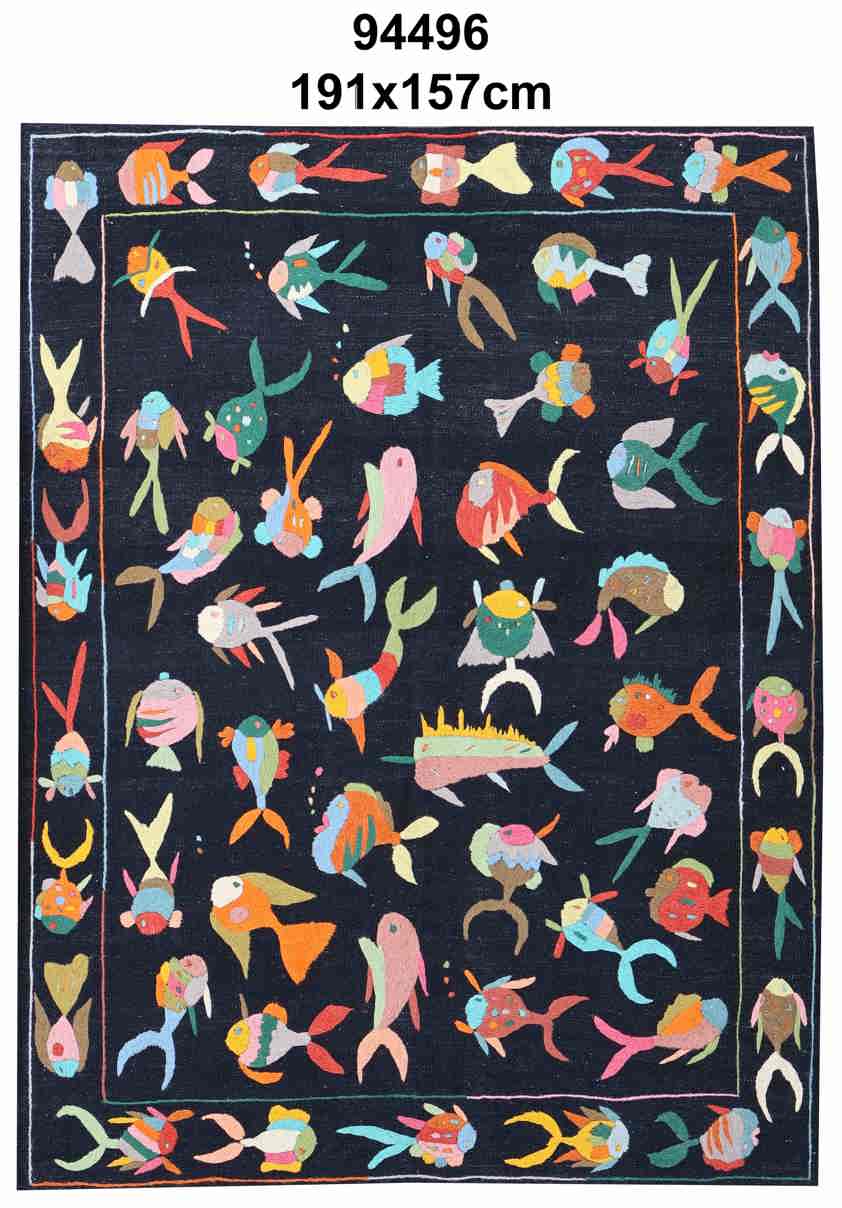
Fish with rounded bodies, long tails and differently shaped fins swim across the dark ground of this rug. Turquoise, pink, orange, yellow and green divide their forms into small areas of colour. Their directions change continually, creating an active field without one fixed centre. Small circular eyes and outlined fins provide the finer details that emerge on closer inspection. The border repeats the aquatic subject at a smaller scale. Pale lines separate this outer band from the main field, giving a clear structure to the otherwise scattered imagery.
Against the deep background, lighter fish appear especially distinct, while darker patches lend depth within their bodies. The result is richly varied but held together by its consistent ground and clearly marked frame. Suzani's historical setting is the embroidered furnishing tradition of Central Asia. Decorative household covers and hangings could include birds and fish alongside more familiar botanical forms. This Afghan kilim develops the aquatic subject into an entire pictorial composition, using changes of silhouette and direction as its main organising devices.
That historical association concerns the imagery, without establishing a particular technique for every coloured detail.Use it where the border can remain visible around a table or between chairs. Pale upholstery would make the dark field more pronounced, while a turquoise object could connect with the fish. Keeping other patterns restrained would allow the distinction between scattered centre and ordered outer band to remain a clear part of the room.