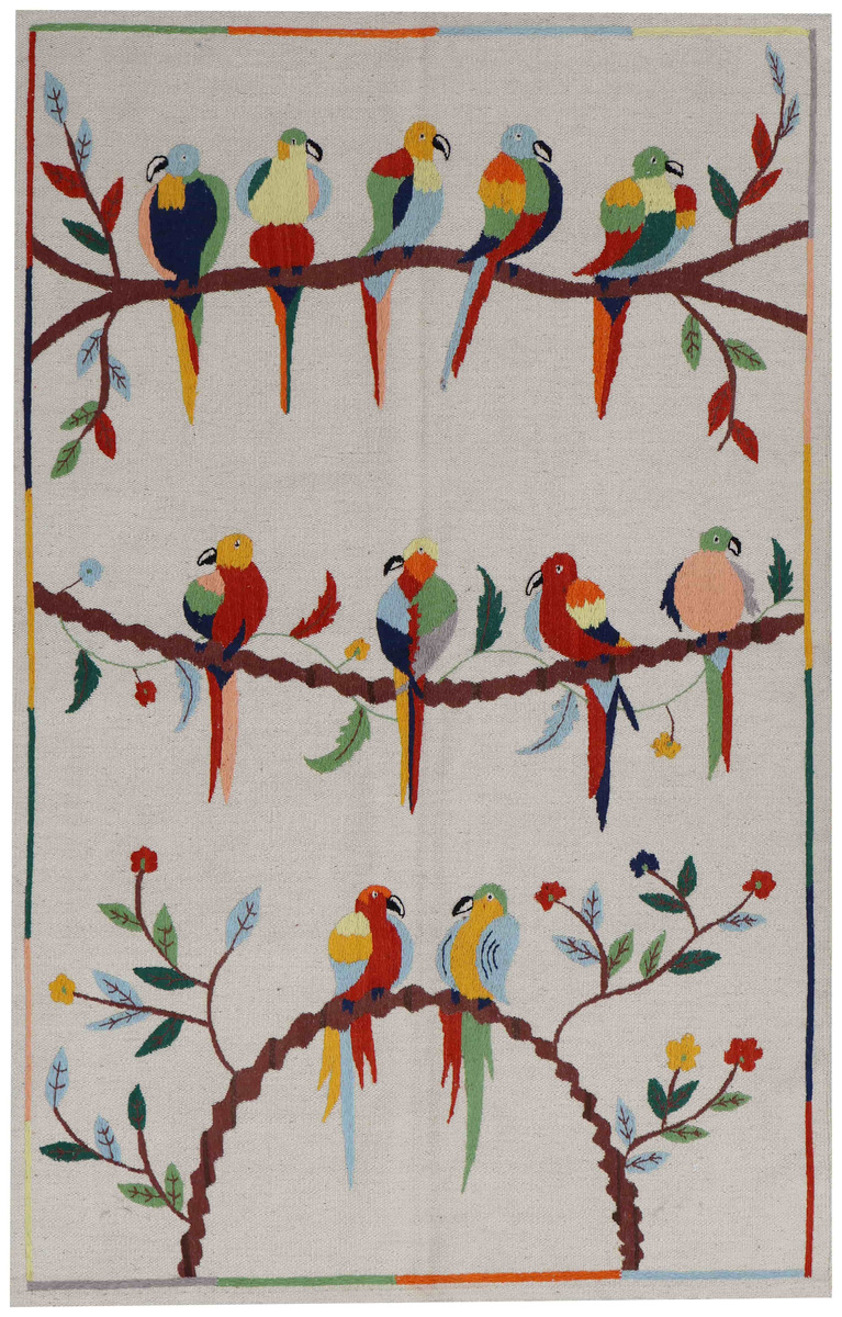
The pale ground of this rug sets off three groups of parrots, each perched on its own section of branching wood. Their long, narrow tails bring vertical strokes of red, blue, green and yellow into the open spaces. Along the upper bough the birds stand close together; below, they are more widely separated. A pair above an arching trunk completes the arrangement near the bottom.
Flowers and small leaves punctuate the branches, adding little accents around the larger birds. The fine perimeter line is divided into different colours, a quiet detail that connects with the varied plumage. Because the background remains largely clear, the illustration can be read easily even when viewed from the far side of a room. There is a useful distinction between the two textile references in its name. Kilim belongs to the family of flatwoven textiles, whereas suzani historically describes Central Asian embroidered covers and other household furnishings.
This Afghan rug brings a pictorial decorative vocabulary into that broader conversation. Its birds and branches are identifiable design subjects, but the photograph alone does not establish a particular embroidery process or attach a traditional meaning to them. Place it where the tiers of birds have room to unfold, perhaps between a sofa and a pair of light chairs. Natural wood would echo the boughs, while plain green or blue cushions could connect with the feathers. Its light background can also soften the transition between darker furniture pieces and the floor.