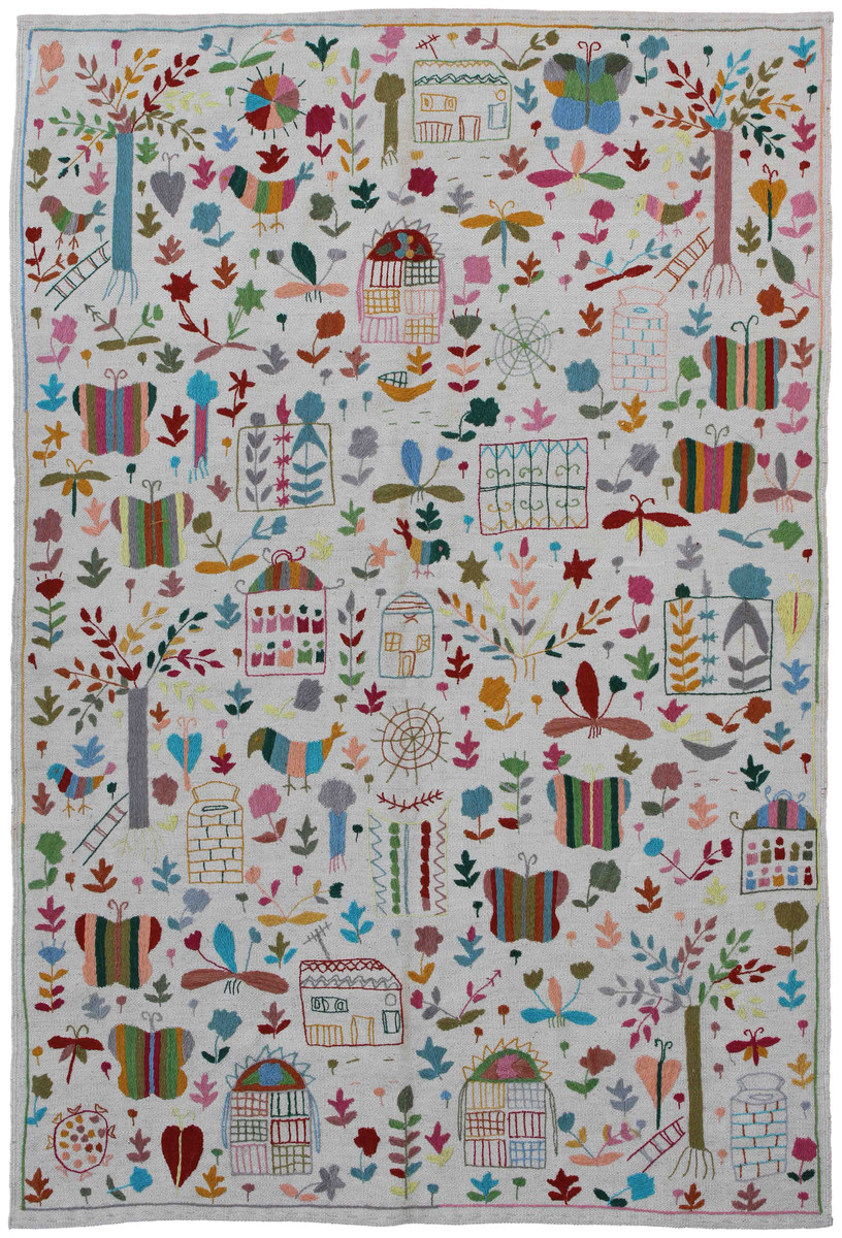
Fine garden panels and broad striped wings share the pale field of this rug. Some little structures have rounded roofs and gridded interiors; others hold isolated plants or coloured compartments. Rooted trees rise between birds, butterflies and wheel-like circles. Red, blue, pink, green and ochre recur in short lines and small enclosed patches, with the light ground visible around the subjects.
The smaller details are particularly varied. A flower may be reduced to a simple star, while a neighbouring leaf has only a thin stem and coloured tip. Narrow ladders and grid-like forms introduce straighter lines beside the looser plants. At 233 × 158 cm, this rug could sit in a bedroom or beside a compact seating group. Plain furniture would allow these changes of scale to remain legible around its edges.
Suzani embroidery historically furnished Central Asian homes, particularly within Uzbek and Tajik communities. Covers and hangings could carry elaborate botanical schemes, balancing larger motifs with fine subsidiary ornament. This Afghan kilim turns that decorative richness towards an assortment of small pictorial incidents. The field has no single indispensable centre. A tall tree, rounded panel or striped form may attract attention first, then lead towards much smaller flowers and little birds. The slim outer line keeps the framing unobtrusive. A pale blue or red accessory could refer to selected passages, while the many light intervals would keep the overall floor pattern relatively open despite its detailed drawing.