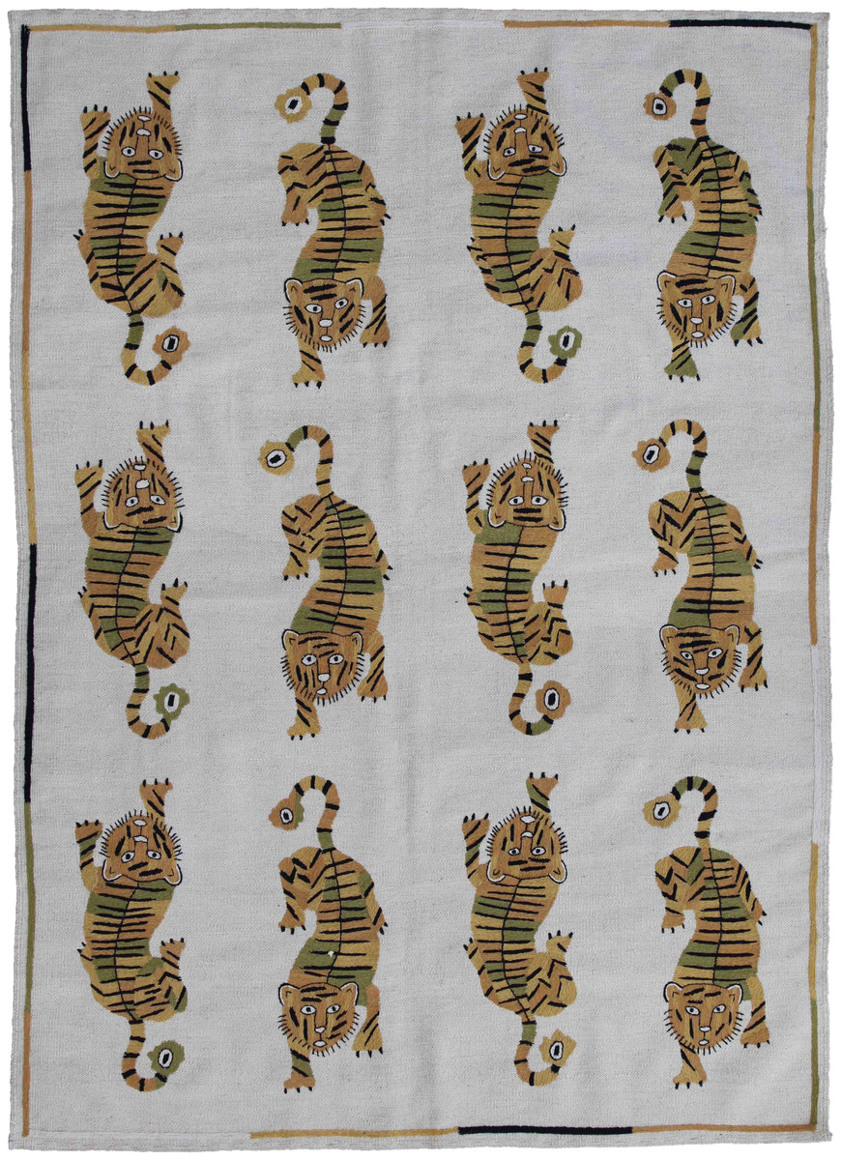
Rows of ochre cats establish a particularly clear pattern on this rug. Upright figures alternate with inverted companions, their curled tails and pointed ears changing direction across the pale ground. Dark stripes follow the rounded bodies, and small facial details distinguish the heads. The repeated subject gives the field an immediate identity, while slight differences in outline keep the individual cats visible within the arrangement.
Suzani has its historical background in Central Asian needlework for domestic interiors. In Uzbek and Tajik communities, elaborately decorated covers and hangings could form part of household and wedding furnishings. That broad textile context accompanies this Afghan kilim, whose focused animal subject offers a more restricted palette and a much simpler organisation than the densely floral historical examples. The spacing matters as much as the stripes. Pale lanes separate the rows, leaving the curved tails easy to trace.
A fine outer line in dark and warmer tones frames the figures without adding another major motif. Measuring 235 × 161 cm, this rug would work particularly well where its centre remains visible, perhaps in a bedroom or beside a small seating group. Plain ochre or cream fabrics could answer the warm bodies and light field. Dark furniture would relate to the stripes. Seen from either end, the alternation brings a different set of upright faces into view, giving the repeated cats a playful but carefully ordered character.