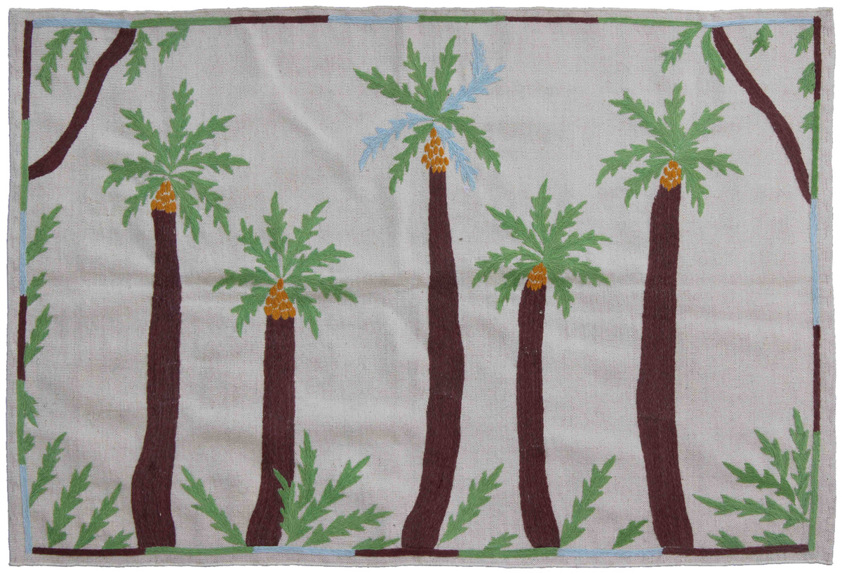
Tall palms divide the pale field of this rug into open intervals. Brown trunks curve slightly as they rise towards green crowns, with yellow fruit-like clusters tucked beneath some of the leaves. Smaller foliage appears along the lower edge, while partial trees enter from the sides. A very fine brown and green outline contains the scene without introducing a separate ornamental border.
The composition has a landscape character. Different trunk heights make the middle trees particularly prominent, and the lighter space between them keeps their individual curves easy to follow. The green crowns vary in breadth and direction, introducing small changes within a deliberately limited subject.
At 173 × 117 cm, this rug could provide a compact pictorial accent in a bedroom or study. Furniture placed to one side would preserve the relationship between the tall palms and the lower leafy passages. Plant imagery is central to the decorative history associated with Suzani. In Central Asia, particularly within Uzbek embroidery traditions, botanical ornament enriched household covers and hangings, sometimes combining broad blossoms with much finer stems and foliage
. The name here accompanies an Afghan kilim with a more direct plant scene. Its palms are recognisable subjects, and the pale gaps around their trunks are as necessary to the drawing as the leaves themselves. Green paintwork could quietly answer the crowns, while warm timber would connect with the long brown vertical forms.