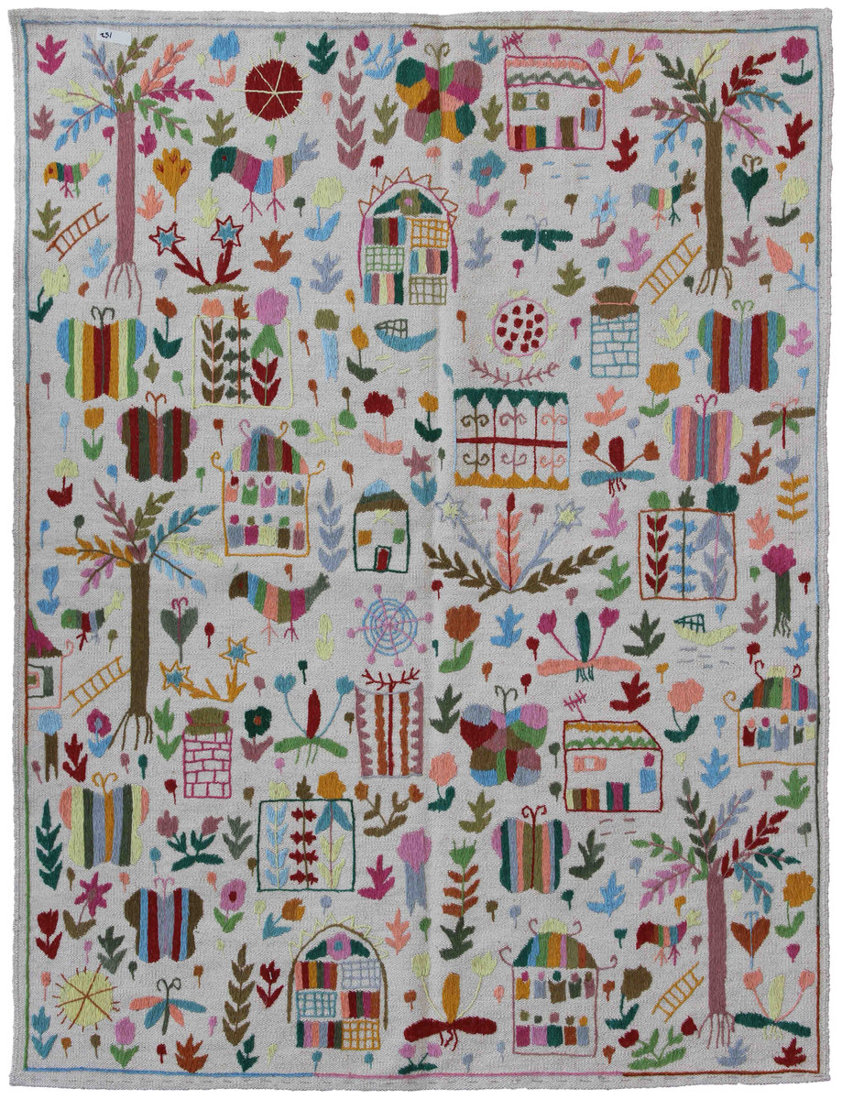
Arched panels give this rug a collection of distinctive little forms. Their interiors contain stripes, grids or separate coloured compartments, with fine flowers and leafy stems scattered around them. Birds, rooted trees and broad butterfly-like figures add other subjects to the pale grey field. Pink, green, blue, yellow and red are used in changing combinations, while a thin multicoloured line marks the outer edge.
The drawing moves repeatedly between broad colour and very fine detail. A striped figure may have only a few large divisions, while a nearby panel holds numerous tiny squares. Suzani takes its name from a Persian word meaning needle, reflecting its historical association with embroidery. Central Asian households used these decorated furnishings as covers and hangings; Uzbek and Tajik communities contributed significant traditions.
The term here accompanies an Afghan kilim, with the shared light ground allowing each imagined panel, plant and figure its own interval of space. Measuring 197 × 150 cm, this rug could bring detailed colour to a bedroom or a compact reading corner. A plain chair would give the nearby subjects a clear setting. One green or blue accessory could establish a colour connection without competing with the full palette. The arched shapes would remain recognisable from across the room. Their finer internal grids, small flower heads and delicate stems would provide a quieter set of details to enjoy at close range.