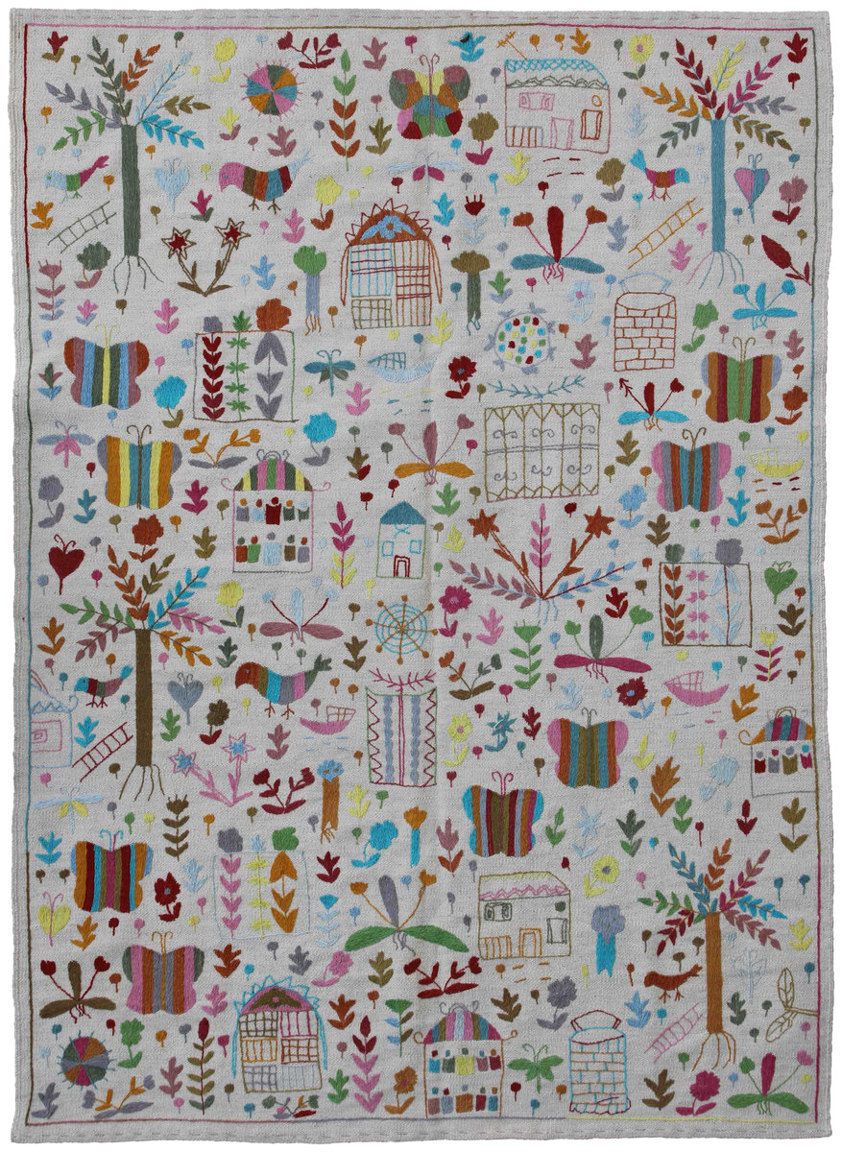
Trees and framed plants introduce several kinds of botanical drawing on this rug. Rooted trunks rise towards spreading leafy crowns, while smaller rectangles contain one or two upright flowering stems. Birds, rounded panels and broad striped butterfly forms appear between them.
The light ground separates the red, blue, green, pink and yellow accents, allowing fine leaves and bolder colour blocks to remain equally clear. The larger panels contain their own small details, including grid-like divisions and coloured compartments. Little circles and scattered flowers introduce more compact shapes around them. In Central Asian Suzani traditions, household embroidery brought richly varied ornament to domestic furnishings. Floral subjects could be developed at several scales, from broad principal motifs to delicate subsidiary stems.
This Afghan kilim uses that decorative variety in a pictorial field, placing individual plants beside little imagined panels and figures rather than concentrating the pattern around one centre. A bedroom furnished in plain fabrics would give this 234 × 167 cm rug’s framed plants room to register clearly. Plain fabrics would give the little framed plants a quiet setting. One blue or green accessory could answer a selected part of the palette. The rooted trees would remain noticeable across the room, while their finer leaves and neighbouring blossoms would reward a closer look. That change of viewing distance is an appealing part of the composition.