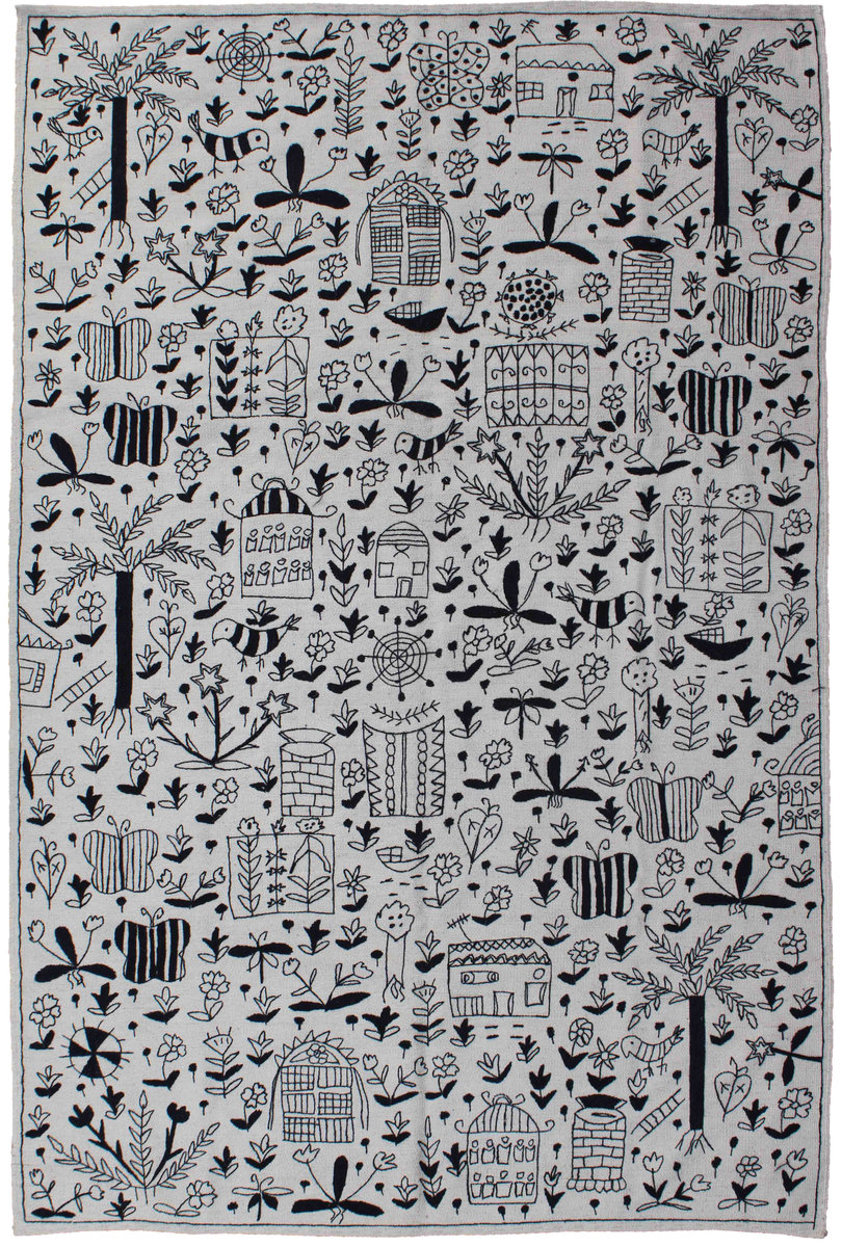
Black drawing turns this rug into a collection of tiny scenes on ivory. Small animals, trees, flowers and little buildings appear beside arched and rectangular panels. Wheel-like circles and striped oval forms add more geometric details. Some subjects are drawn with slender outlines, while others have solid dark bodies, giving the densely occupied field a varied rhythm.
The Suzani name has its background in Central Asian needlework, particularly embroidered furnishings from Uzbek and neighbouring settled communities. Historically, these textiles served domestic and ceremonial uses, with strong motifs giving interiors colour and ornament. This Afghan kilim takes the decorative reference into a contemporary graphic direction, relying on contrasting line weights rather than a broad palette. At 289 × 191 cm, this rug would bring substantial detail to a study or a family sitting space.
Plain furniture would leave the smaller subjects easier to recognise. It could also work in a room already containing colourful artwork, since the black and ivory supply a measured base. Close views beside a chair would reveal the changing little panels, plants and animals that distinguish one section from another. The monochrome palette makes those differences especially clear. A fine plant stem can sit beside a broad animal silhouette, and a closely lined panel contrasts with a more open wheel. Ivory remains visible between the subjects, preventing the assortment from becoming one continuous dark surface. Narrow lines at the perimeter provide a quiet finish.