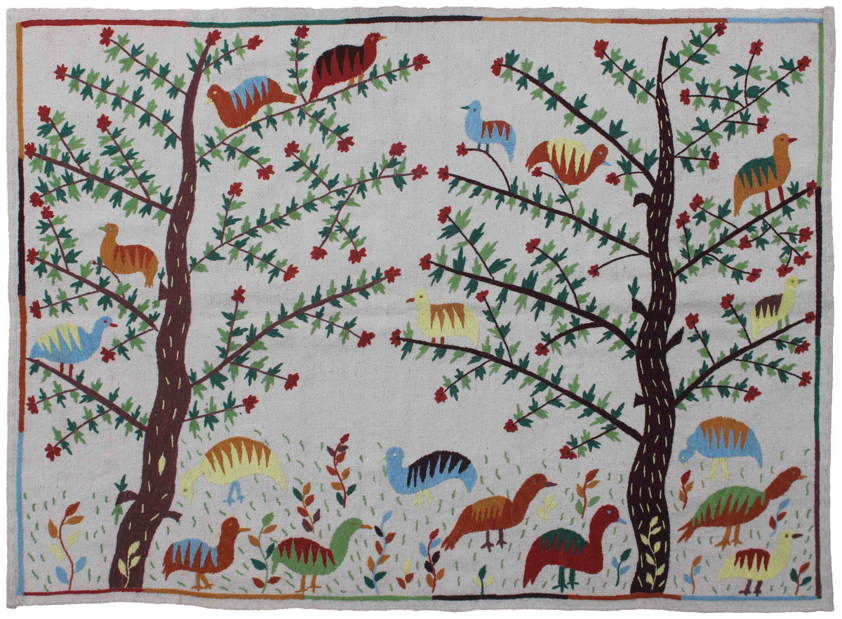
Two branching trees give this rug a clear landscape arrangement. Their brown trunks rise through a pale ground, sending fine green branches towards the sides and upper edge. Tiny red bird-like forms punctuate the foliage, while larger colourful animals occupy the spaces beneath and between the trees. A narrow multicoloured outline follows the perimeter.
The scale changes markedly within the scene. Small leaves and red marks are delicately spaced along the branches, whereas the animals are broader, simpler silhouettes. Orange, blue, green and burgundy give those figures separate identities. The pale ground allows the trees to remain clearly legible, even where their many slender branches cross the field.
At 229 × 169 cm, this rug could enliven an open bedroom area or a small family sitting space. Its composition would be particularly rewarding where the trunks and spreading branches could be seen together. Plain furniture would give the smaller leaves room to remain apparent. A warm wooden cabinet could relate to the brown trunks, while a single blue or orange textile would pick up one of the larger animal forms without competing with the full scene. Trees, birds and flowers are familiar subjects within Central Asian decorative textile traditions, including the broader repertoire associated with Suzani furnishings. Historically, embroidered pieces brought ornament into household interiors, often combining bold subjects with finer botanical details. This Afghan kilim develops that reference into a contemporary scene organised around two substantial trees.