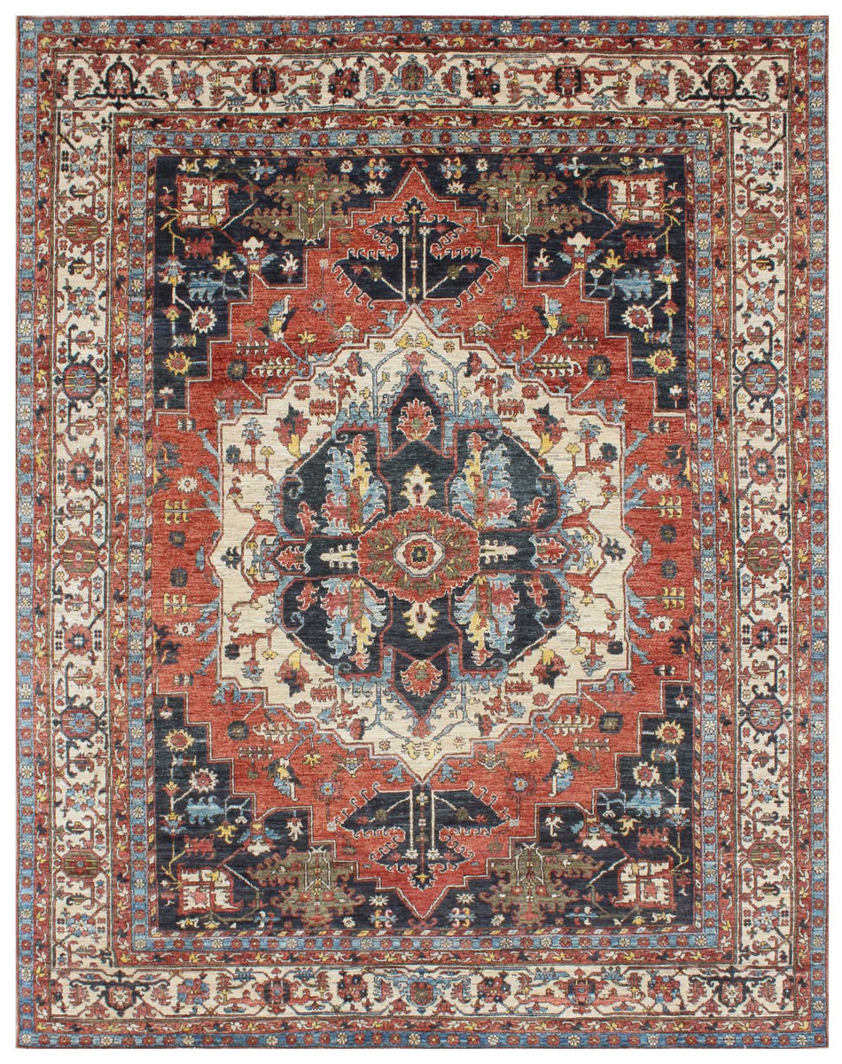
Terracotta gives this rug a warm field for its strongly drawn central medallion. Dark blue petals and projecting points surround a small round rosette, with an ivory shaped section separating the centre from the surrounding red-orange. Fine geometric flowers and branches occupy the corners, while a light botanical border creates a clear outer frame. Small pale blue and ochre details soften the stronger colour divisions.
The Serapi reference connects this Afghan rug with the broader Heriz design family of northwestern Iran. That tradition is particularly associated with angular medallions and geometric interpretations of floral ornament. Here, stepped outlines give the composition an architectural clarity, while the smaller flowers maintain a lighter, more varied scale of detail. At 307 × 254 cm, this rug would be well suited to a substantial seating arrangement. Plain ivory upholstery would relate to the central surround and outer border, while dark timber could answer the blue medallion.
A single pale blue accent elsewhere could bring forward the quieter details without distracting from the terracotta field. The corners are worth leaving visible where possible. Their little branching forms fill the dark areas without becoming a continuous mass, and the stepped ivory edges lead the eye back towards the centre. The border repeats a finer botanical rhythm around the whole arrangement. Together, those parts give this rug a balance between a bold, immediately recognisable plan and the many small ornaments that become apparent on closer inspection.