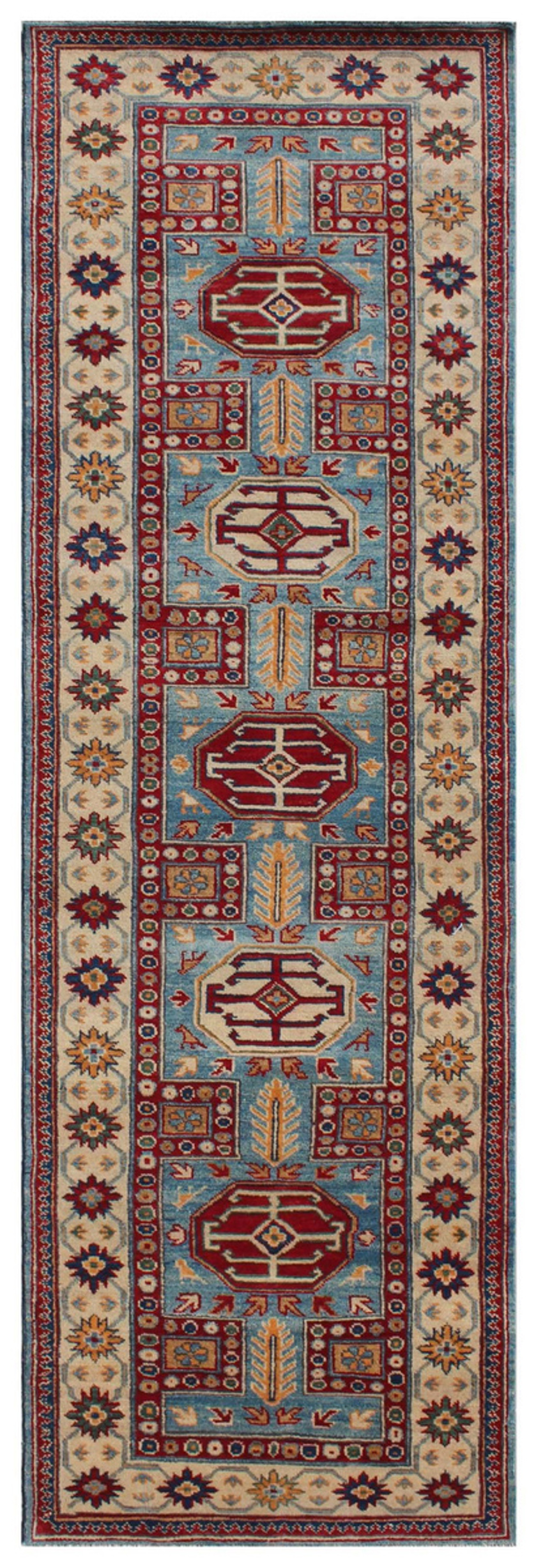
Alternating red and pale medallions give this rug a steady central sequence. Their dark internal lines stand clearly against the blue ground, while smaller rectangles and narrow angular motifs fill the surrounding field. A border of little star-like forms encloses the design, separated from the centre by fine coloured bands.
This rug would make particular sense in a long passage, where the changing medallions could be seen along the floor. Its 83 by 301 centimetre proportions leave little empty ground, concentrating a varied geometric vocabulary within a narrow rectangle. Cream walls would relate to the pale details, while dark timber could pick up the stronger outlines within the red forms. The Kazak design tradition is associated with carpet-producing areas of the southern Caucasus. Strong geometry and the clear relationship between field and border are among its familiar features.
This Afghan Kazak rug develops that decorative language in an elongated composition, giving the repeating central ornaments a directional role. Look at the small divisions beside the medallions and they introduce further changes of blue, gold and red. The detail is dense, but the pale outer band prevents the whole design from becoming visually heavy. From further away, the red-and-ivory sequence establishes the pattern. Nearer by, the little stars and internal medallion lines become clearer. This rug rewards a setting where its outline remains visible, preserving the balance between a richly patterned centre and the lighter frame around it.