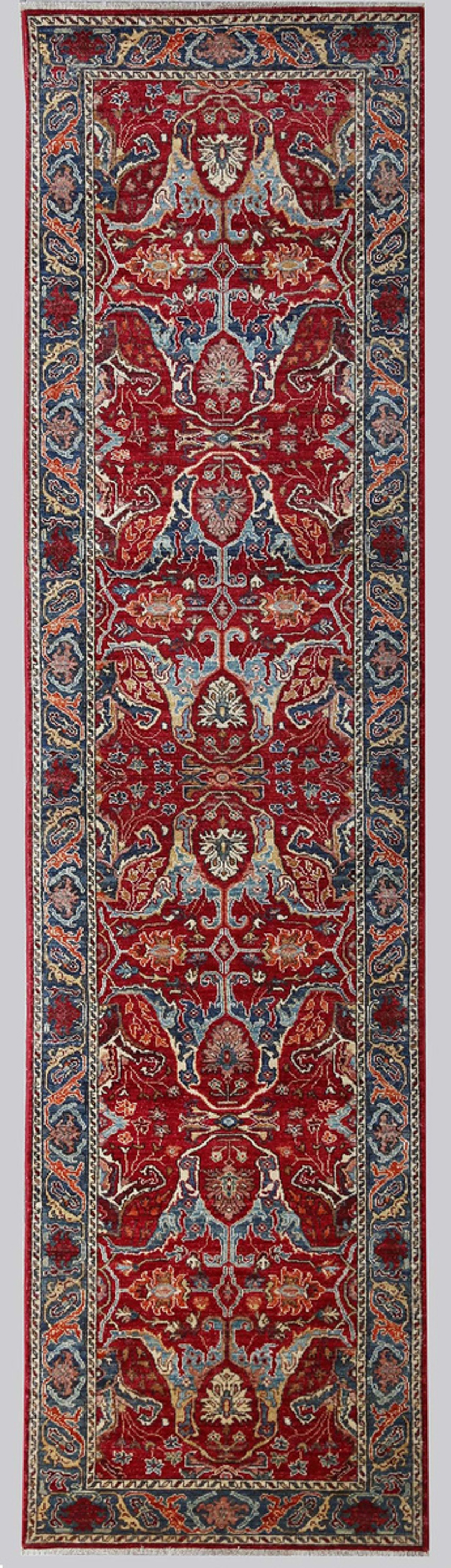
Repeated pale botanical forms fill the red centre of this runner. Large leaf-like ornaments open out from slender stems, with smaller curled details linking them along the length. Blue, ivory and muted gold distinguish the finer drawing. The dark blue border carries its own continuous vine, giving the warm inner field a firm, cooler frame.
The Arts and Crafts movement developed in nineteenth-century Britain with a renewed interest in the relationship between design, materials and making. Nature supplied a particularly important source of ornament, as seen in the textile work associated with William Morris and his contemporaries. This Afghan runner uses Arts and Crafts as a design reference, arranging stylised botanical forms within a clearly organised decorative field. The repeat has enough variation in scale to remain interesting nearby. Larger pale leaves establish the main rhythm, while tiny stems occupy their intervals. Red space separates the stronger forms, preventing the narrow centre from becoming visually congested. The border drawing is smaller and steadier, providing a measured edge around the more expansive inner leaves.
At 352 × 90 cm, this runner would bring a substantial botanical accent to a hallway. Dark timber panelling or furniture would relate to the blue frame, while cream walls could pick up the pale leaves. Its long repeat would also work beside bookcases or a series of doorways, where the changing plant forms could be appreciated in successive views along the passage.