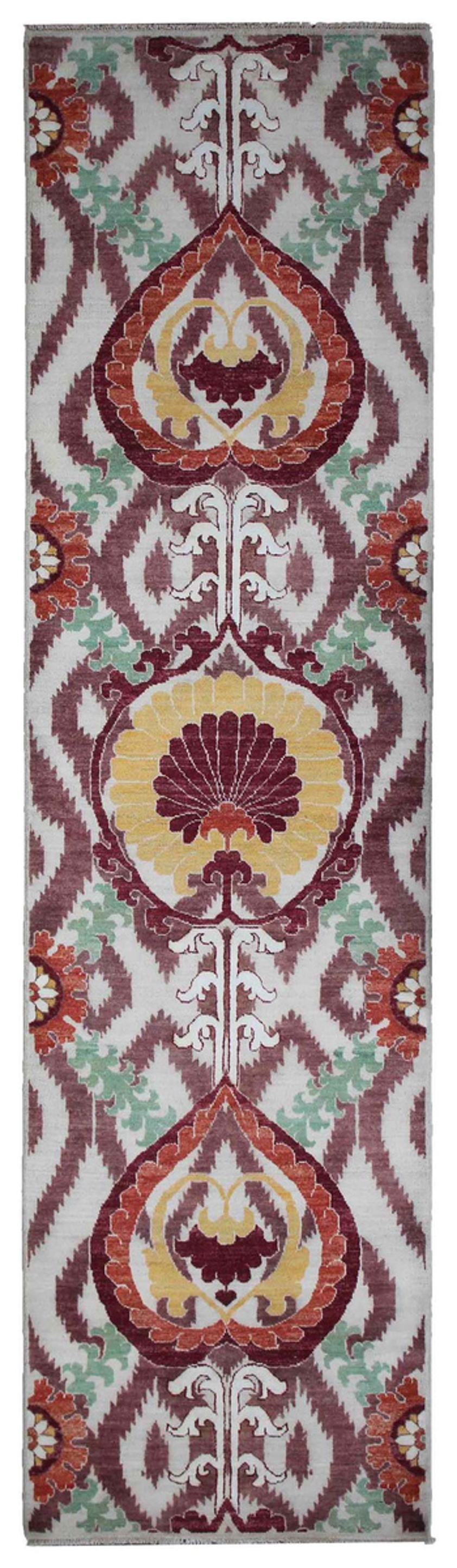
Large palmette-like forms alternate down this runner, their red and golden interiors enclosed by sweeping pointed outlines. Pale curling stems rise between them, with soft green areas providing a cooler contrast. The repeat is deliberately large for the narrow format, allowing the principal botanical shapes to dominate the length.This runner makes a strong connection between floral ornament and geometric structure. Rounded flower heads sit within pointed enclosures, while the stems create a clear vertical axis.
The background remains visible around them, giving the larger red forms enough space. A slim outline marks the edges without introducing a competing outer border. The Arts and Crafts movement drew extensively on stylised plants and historical textile design. William Morris's study of Persian carpets was an important influence on his own carpet work in the late nineteenth century. This Afghan Arts and Crafts runner belongs to that wider decorative conversation, using an ordered botanical repeat with a particularly bold change of scale.
At 84 by 309 centimetres, this runner would suit a hall where the full sequence can be seen. Warm wood would relate to the golden flower heads, while pale painted joinery could pick up the light stems. Muted green walls would offer another sympathetic setting. The large motifs are most effective when they remain uncovered, allowing their alternating shapes and the fine connecting foliage to be appreciated together along the floor.