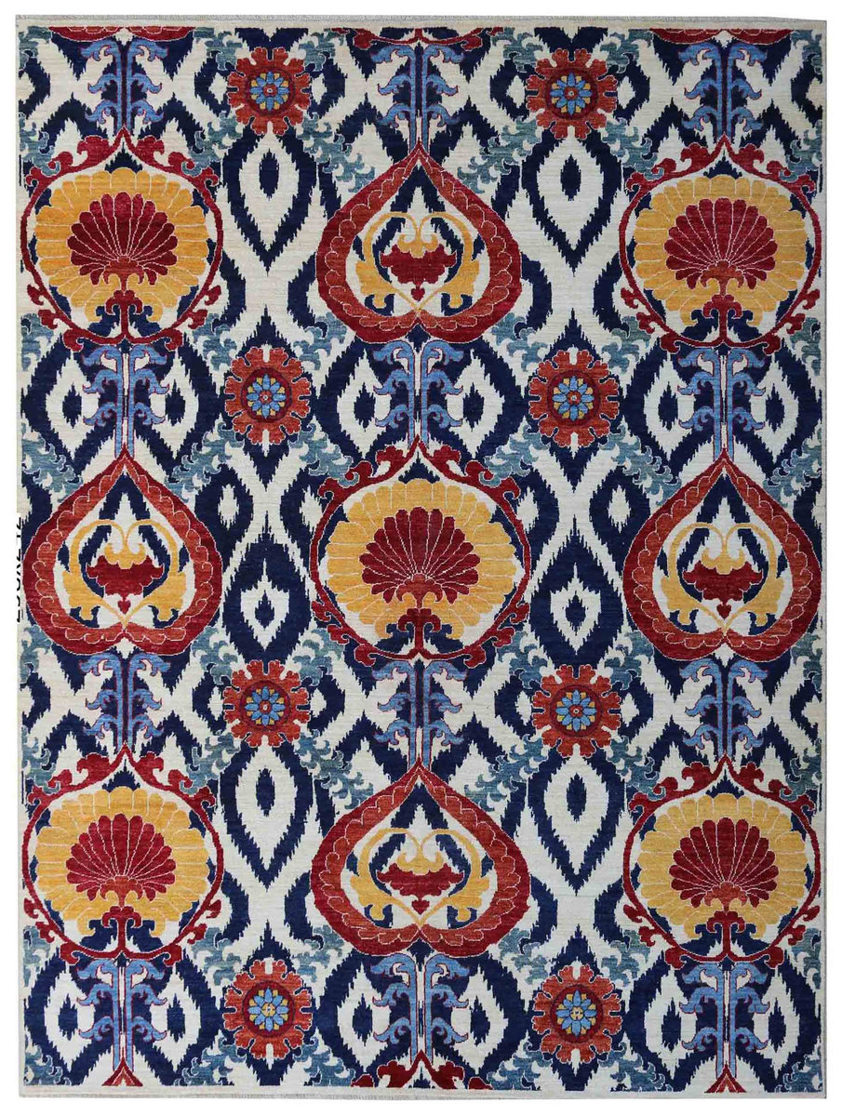
Red and golden botanical forms give this rug a bold, sustained repeat. Rounded flower heads alternate with pointed enclosures, set against a navy and ivory network of angular shapes. Fine stems connect the larger ornaments, with smaller red flowers providing additional points of colour between them. The composition is especially strong where a golden interior meets a dark blue outline. That contrast keeps the broad shapes clear even where the background becomes intricate.
This rug has no separate central medallion: the same botanical vocabulary continues across the rectangle, making the visible areas around furniture part of a consistent larger arrangement. The Arts and Crafts movement placed particular emphasis on stylised plants and the organisation of repeat patterns. Historical carpets from Persia were important sources for designers such as William Morris.
This Afghan interpretation develops that connection through enlarged floral forms and emphatic colour. At 242 by 298 centimetres, this rug could define a substantial seating area with enough pattern exposed beyond a table. Plain upholstery would give the red and gold space, while dark timber would relate to the navy. A room with warm white walls could keep the stronger colours clear without repeating them elsewhere. The small connecting flowers are worth viewing nearby, where they introduce a finer rhythm between the large pointed shapes. Those changes of scale give this rug detail beyond its immediate, strongly coloured impression.